
By Dr. Dan Schauff, Ph.D., P.A.S.
Practical and research observations have long shown a healthy calf is more likely to become a healthy, productive dairy cow. Most also recognize that a successful colostrum feeding/management program is essential and foundational to support a calf’s health, future growth, and milk production. There is growing evidence, however, that the close-up dry cow’s nutritional and environmental status also can impact a newborn heifer calf’s future health, growth, and productivity.
This likely occurs both indirectly through their effects on colostrum quantity and quality, and directly in utero via fetal programming. (Mee, 2022)
In other words, the close-up dry cow’s nutritional and environmental status can influence the development and maturity of a fetus’ immune and digestive system.
Selenium and vitamin E supply to close-up dry cows are very important to support immune function mediated by enhancing the selenium-containing enzyme activity of glutathione peroxidase and preventing white muscle disease in newborn calves. (Underwood and Suttle, 1999)
Optimizing the supply of selenium and vitamin E to close-up cows can increase the selenium, vitamin E, and immunoglobulin content in the colostrum of fresh cows. (Pavlata et al., 2004)
Due to the availability of selenium yeast ingredients and the practice of supplying in excess of 2,000 IU/hd/d of vitamin E to close-up dry cows, selenium/vitamin E status has been much less of an issue.
Trace minerals such as copper, manganese, and zinc are important co-factors to enhance immune function. Replacing sulfate forms of copper, manganese, and zinc with more bioavailable organic trace mineral sources to close-up dry cows resulted in increased wither heights in their calves measured at 1-8 weeks of age (Jacometo et al., 2015).
They also observed calves whose dam received organic trace minerals had an enhanced immune cell function (Jacometo et al., 2015). The researchers isolated the immune cells from the blood of calves before they consumed colostrum. Consequently, this indicates the improved immune function was likely influenced in utero and not from colostrum feeding.
The authors concluded “these results indicate that maternal nutrition with organic trace minerals could alter the neonatal innate immune response at least in part via changes in gene and mRNA expression.” (Jacometo et al., 2015)
Provided close-up dry cows are fed rations containing 14-15% protein (1200-1350 grams of available protein), there does not appear to be an advantage to feeding more than the aforementioned levels to improve colostrum quality, quantity, and newborn calf health.
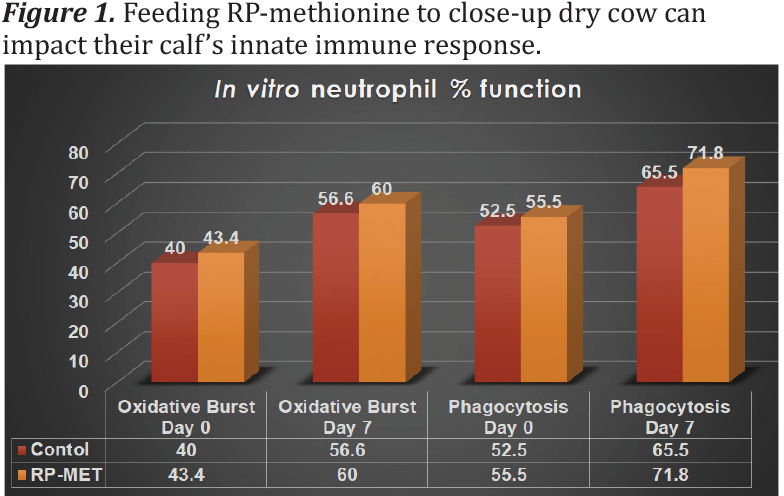
However, recent research indicates feeding RP-methionine to close-up dry cows may positively affect their newborn calf’s health and immunity. The authors concluded maternal feeding of RP-methionine for 28 days before calving “enhanced the ability of circulating innate immune cells of the calf to respond to a pathogen challenge in early life.” (Alharthi et al, 2018; Figure 1)
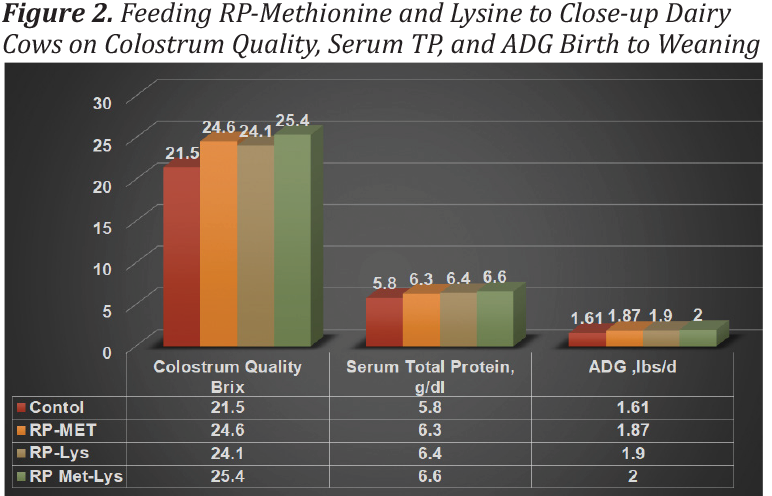
In another study, feeding RP-lysine and methionine to close-up dry cows resulted in improved colostrum (Brix) quality in the dams and a higher total serum protein (Wang et al.,2021; Figure 2) in their calves compared to calves from non-supplemented cows. In addition, calves from lysine- or methionine-supplemented cows had greater average daily gains and weaning weights compared to control calves. (Wang et al., 2021; Figure 2)
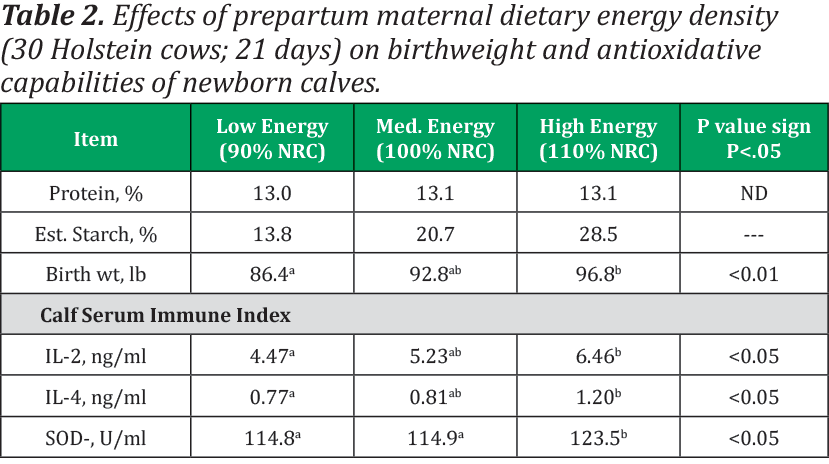
Optimizing energy density in close-up beef and dairy cow rations can also have a positive impact on birth weight, immune status, and antioxidative capabilities of newborn calves. (Chen et al, 2022; Table 1 and Gao et al., 2012; Table 2)

Agri-King has observed improvements in close-up cow dry matter intakes, freshening outcomes, and colostrum production when close-up rations contain 18-25% starch vs 12-16% starch. The exact level of recommended ration starch content depends on starch form (dry or fermented), particle size, and starch content in the lactation ration.
Studies conducted at the University of Florida looked at the effects of dry cow heat stress on the calf’s immune status, growth, future milk production, and longevity. (Dahl et al., 2016)
Calves born from cows that were under late-gestation heat stress had lower birth rates and shorter stature at weaning at 12 months of age compared to calves from cows that were cooled during their dry period (Dahl et al., 2016).
Calves that suffered heat stress in utero produced 11 pounds less milk through 35 weeks of their first lactation. (Dahl et al., 2016)
Results from a retrospective study (2009-2022) at the University of Illinois indicated that heifer calves born during the summer months produced less milk and had shorter longevity compared to heifer calves born during non-summer months. (Brost and Drackley, 2023)
Consequently, cooling and heat abatement of dry cows is just as important as it is for lactating cows because it has far-reaching effects on heifer calves’ future productivity.
Most know that a close-up cow’s environment and health affects freshening outcomes, breeding efficiency, and milk production. However, there is growing evidence the nutritional and environmental status of close-up dry cows can also impact other areas. These include immune function, health, growth, and future productivity in their heifer calves.
This impact is likely mediated through colostrum quality and quantity and directly through fetal programming in utero. Optimizing close-up ration protein content, amino acid supplementation, energy content, DCAD balance, and trace mineral/vitamin supplementation are essential to maximize fresh cows and their calves’ health and performance.
Agri-King designed LDH Fortifier, Tri-Max, VT-Max, DC Micro Pak, and Super Micro to supply transition cows’ and their calves’ vitamin/trace mineral requirements.
Tri-Lution is a unique, direct-fed microbial that assists the rumen in pre- and post-fresh cows. It helps optimize the microbial environment of transition cows’ and newborn calves’ gastrointestinal tracts — one of the immune system’s first lines of defense.
Contact your local Agri-King representative on how we can customize a transition cow feeding/management program to optimize the health and productivity of your cows and heifers. AK
Colostrum – The Why, When, and How to Feed