
By Dr. David F. Jones, Ph.D., P.A.S.
Sugars are the most basic form of carbohydrates composed of monosaccharides (containing one sugar molecule, like glucose, fructose, and galactose) or disaccharides (two sugar molecules, like lactose, sucrose, and maltose). They are soluble in water, have a sweet taste, and are rapidly fermented in the rumen (Figure 1).1

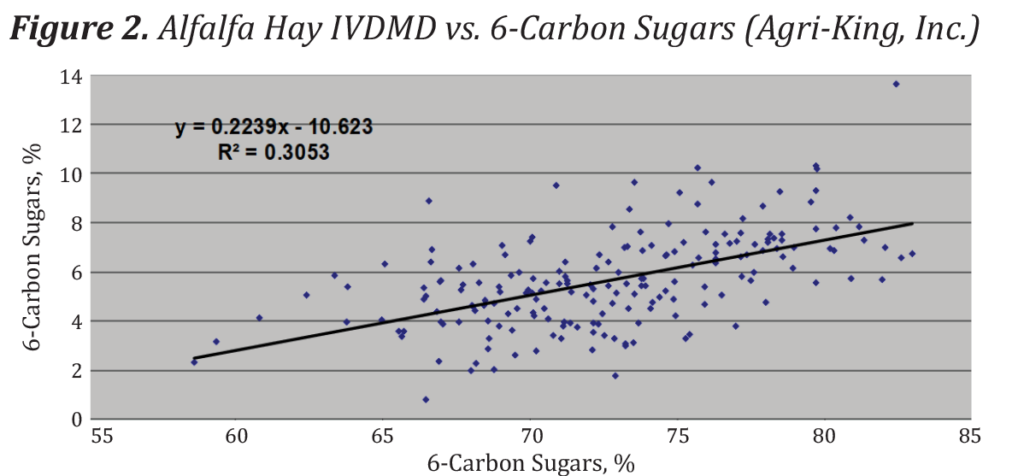
Forages, such as grass or alfalfa, are an important source of sugar in lactation rations. As the plant is exposed to sunlight, it will use photosynthesis and produce sugar. As the sugar concentration increases, the dry matter digestibility of the forage also tends to increase (Figure 2). This is why it is recommended to mow in the afternoon after the grass or alfalfa have been exposed to sunlight and had time to increase their sugar content.
Whether from forage or sugar-based commodities, there are several reasons to feed sugar in lactation rations:
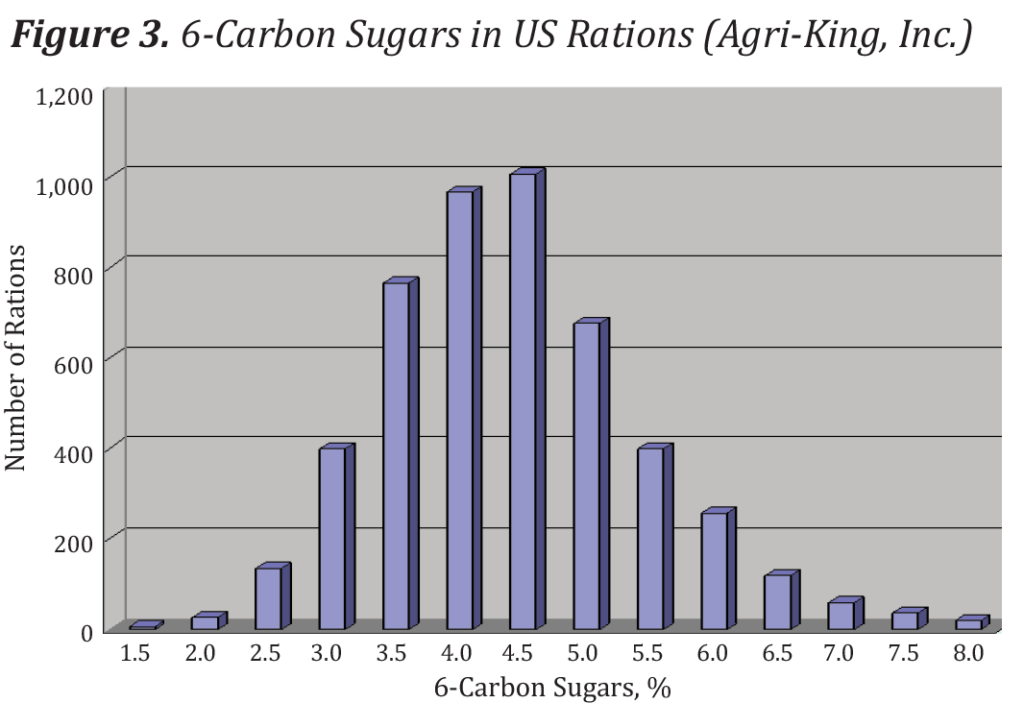
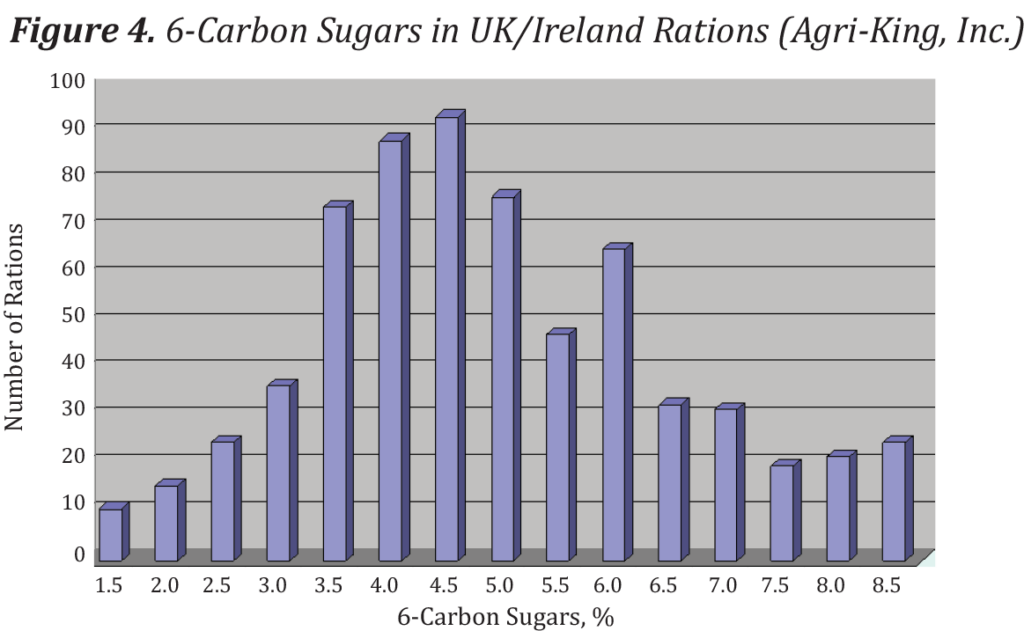
Along with increased fiber digestion, an increase in milk true protein suggests improvement in microbial protein yield (microbial protein growth) when dietary sugar is added to lactation diets. However, sugar is often fed below desired concentrations in lactating dairy diets with differences observed globally (Figures 3 and 4).
These frequency diagrams show a large portion, although not all, of rations fall below 5% sugar. Rations from the UK/Ireland tend to have more rations with sugar values between 5-7% of dietary dry matter, likely due to timely harvest of grass and the pasture-based system used in Ireland. Dietary starch should be kept between 22-27% when adding sugar to the diet.4
Based on a meta-analysis, cows producing greater than 33 kg (72.7 lb) of milk should have the best response to added dietary sugar in the range of 5-7% of diet dry matter.4 This should not be a surprise because cows producing more than 70 lb of milk typically have a rumen environment that is ready to take advantage of nutrients such as sugar.
Interestingly, the addition of sugars in lactation diets does not seem to reduce rumen pH like the addition of starch can. Some reasons include:
Butyric acid is a precursor for milk fat, but it is also an important source of energy for the epithelial cells of the rumen. It has been suggested that increased concentrations of butyric acid in the rumen may improve rumen epithelial cell absorption of acids and glucose.5,6 Absorption of acids removes them from the rumen environment, which will maintain a more optimal ruminal pH and assist fiber-digesting (cellulolytic) microbes that break down fiber (cellulose) to produce acetic acid, another milk fat precursor.
Despite the benefits of butyric acid on milk fat, we must be cautious of high butyric acid concentrations and the potential effect on blood chemistry. Agri-King research found, in high enough concentrations, butyric acid can lead to a negative effect on dry matter intake. An increase in plasma β-Hydroxybutyrate (BHBA) with high sugar diets (8.4% of diet DM) has been observed and can lead to increased NEFA concentration in post-fresh cows (early lactation), which is a potential risk for ketosis.8 It is important not to exceed 7% of dietary dry matter and to be conservative if adding sugar to diets consumed by early lactation cows.
Hall has shown that rumen microbes can store glucose as glycogen.7 This means the glucose was not fermented, thus reducing acid production in the rumen. Like the effects of butyric acid, this would create a beneficial environment for cellulolytic bacteria improving fiber digestion and acetic acid production for milk fat synthesis.
Feeding a high-sugar diet (8.4% of diet DM) tended to increase milk fat.8 In this study, milk tested lower in C18:1-trans fatty acid concentration, which is an indication of improved biohydrogenation in the rumen (a process necessary to maintain milk fat concentration). This is a further indication of improved rumen microbial growth and function when cows are fed dietary sugar.
Some dietary sources of sugar to consider are:
It is important to properly balance sugar in lactating cow rations. Focus on the sugars provided by forage in the ration first and supplement other sugar sources to balance sugar between 5-7% of dietary dry matter. Agri-King’s Analab routinely performs sugar analysis on feedstuffs, providing a sugar concentration that can be used in ration formulation. Agri-King’s ration balancing program monitors the sugar balance in lactating dairy rations. Have your Agri-King nutrition consultant tune up the sugars in your ration. AK
References:
1 Johnson, R. R. 1976. Influence of carbohydrate solubility on non-protein nitrogen utilization in the ruminant. J. Anim. Sci. 43:184-191.
2 Sniffen, C. J., O’Connor, J. D., Van Soest, P. J., Fox, D. G. and Russell, J. B. 1992. A Net carbohydrate and protein system for evaluating cattle diets: II. Carbohydrate and protein availability. J. Anim. Sci. 70: 3562-3577.
3 Broderick, G. A., N. D. Luchini, S. M. Reynolds, G. A. Varga, and V. A. Ishler. 2008. Effect on production of replacing dietary starch with sucrose in lactating dairy cows. J. Dairy Sci. 91:4801-4810.
4 M. B. de Ondarza, S. M. Emanuele, and C. J. Sniffen. 2017. Effect of increased dietary sugar on dairy cow performance as influenced by diet nutrient components and level of milk production. The Prof. Anim. Sci. 33:700-707.
5 Penner, G. B., M. A. Steele, J. R. Aschenbach, and B. W. McBride. 2011. Molecular adaptation of ruminal epithelia to highly fermentable diets. J. Anim. Sci. 89:1108-1119.
6 Oba, M., J. L. Mewis, and Z. Zhining. 2015. Effects of ruminal doses of sucrose, lactose, and corn starch on ruminal fermentation and expression of genes in rumen epithelial cells. J. Dairy Sci. 98:586-594.
7 Hall, M. B. 2017. Sugars in dairy cattle rations. Pages 135-146 in Proc. 26th Tri-State Dairy Nutr. Conf. Ohio State Univ., Columbus, OH.
8 Penner, G. B. and Oba, M. 2009. Increasing dietary sugar concentration may improve dry matter intake, ruminal fermentation, and productivity of dairy cows in the postpartum phase of the transition period. J. Dairy Sci. 92:3341-3352.