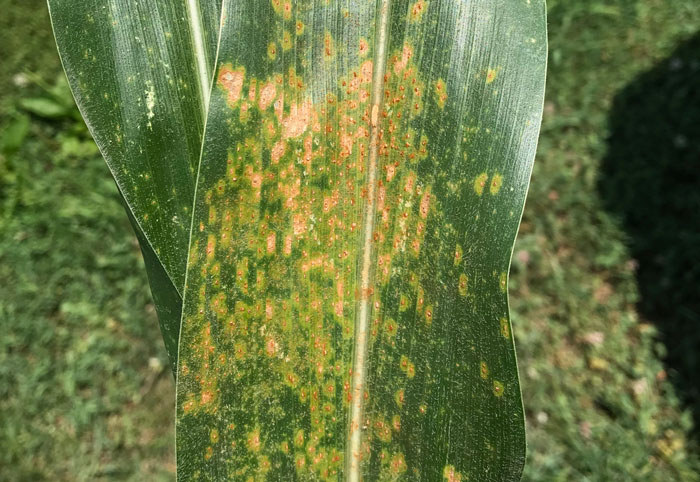
Southern rust is a disease caused by the pathogen Puccinia polysora, which produces fuzzy pustules or bumps on the leaves and stalks of corn. Within these pustules are thousands of small orange spores (where the disease name “rust” comes from) that can spread to other corn plants by wind for several miles1. Symptoms of southern rust infection can be seen in 3-4 days and new spores can be produced 7-10 days after infection1. While common rust prefers cooler and wetter conditions, southern rust thrives in temperatures ranging from 75°F to 93°F and at least four consecutive hours of leaf wetness. Additionally, southern rust has been observed to actively spread in daytime temperatures as hot as 110°F1. The disease does not overwinter in most parts of the northern United States, but the ease with which it travels through the air allows it to thrive further north when conditions are right.
Southern rust primarily diverts nutrients away from the corn plant and reduces photosynthesis2. These struggles result in reduced grain fill, lowering the starch content, creating yield losses, and dropping overall forage quality. In addition, early dry down can occur with the presence of southern rust2. This can lead to higher fiber content and create problems with proper packing, which increases the risks for poor fermentation and higher mold/yeast populations2.
Unfortunately, problems can arise well beyond harvest. Because southern rust severely weakens corn plants, other diseases like Fusarium stalk rot and Gibberella stalk rot have an opportunity to grow and spread. These diseases do produce the mycotoxins fumonisin and vomitoxin (deoxynivalenol)3.
If detected early, southern rust can be treated with fungicides, specifically in the R3 growth stage or prior. However, a second application may be necessary if conditions are still ideal for the spread of southern rust1.
Should a southern rust infestation be detected in later stages or closer to chopping and fungicide cannot be applied, an effective forage treatment product is important to help control fermentation and limit the ability for molds and other spoilage sources to thrive. Once harvest is complete, sample feed regularly to understand the quality of the forage and know if mycotoxins may be present. Ration changes and additional supplementation may be necessary to counteract any problems within the feed.
References:
1Kleczewski, N. “Southern Rust in Corn: Disease Development and Fungicide Use.” farmdoc daily (10): 17, Department of Agricultural and Consumer Economics, University of Illinois at Urbana-Champaign, January 30, 2020.
2Adesogan, Adegbola & Queiroz, O. & Kim, Sam Churl. (2008). Effect of Rust Infestation on Silage Quality. Proc. XVth International Silage Conference.
3Gruss, S. “Corn Diseases and Silage Implications: What to Look for as You Prepare for Harvest” Integrated Crop Management News, Iowa State University Extension and Outreach, August 20, 2025.