By Grace Thomas, M.Agr.Sc. P.A.S.
With 22% of the world’s dairy herd showing signs of lameness and the prevalence of lameness in herds showing little change over the last 30 years (Thomsen et al., 2023), tackling this issue should be a priority for most farms. Lameness not only has a negative impact on animal welfare, but it also has multiple negative effects on the cow, such as reduced fertility, milk yield, and body condition.
Subsequently, lame cows are more likely to leave the herd early. Along with the physical effects on the cow, there is also a financial cost associated with lameness for the producer. The average cost of a lame cow costs the producer $336.91 in the United States (Robcis et al., 2023), £322 in the United Kingdom (Kingshay, 2025), and €318.90 in the Republic of Ireland (Conneely and Ryan, 2024).
Cows tend to become lame due to physical, biological, environmental, or nutritional factors. It can be an individual effect or a combination of these factors. Identifying the main cause of lameness in a herd is the first step in determining how to address the issue. Common types of lameness, the cause, and mechanisms are listed in Table 1.
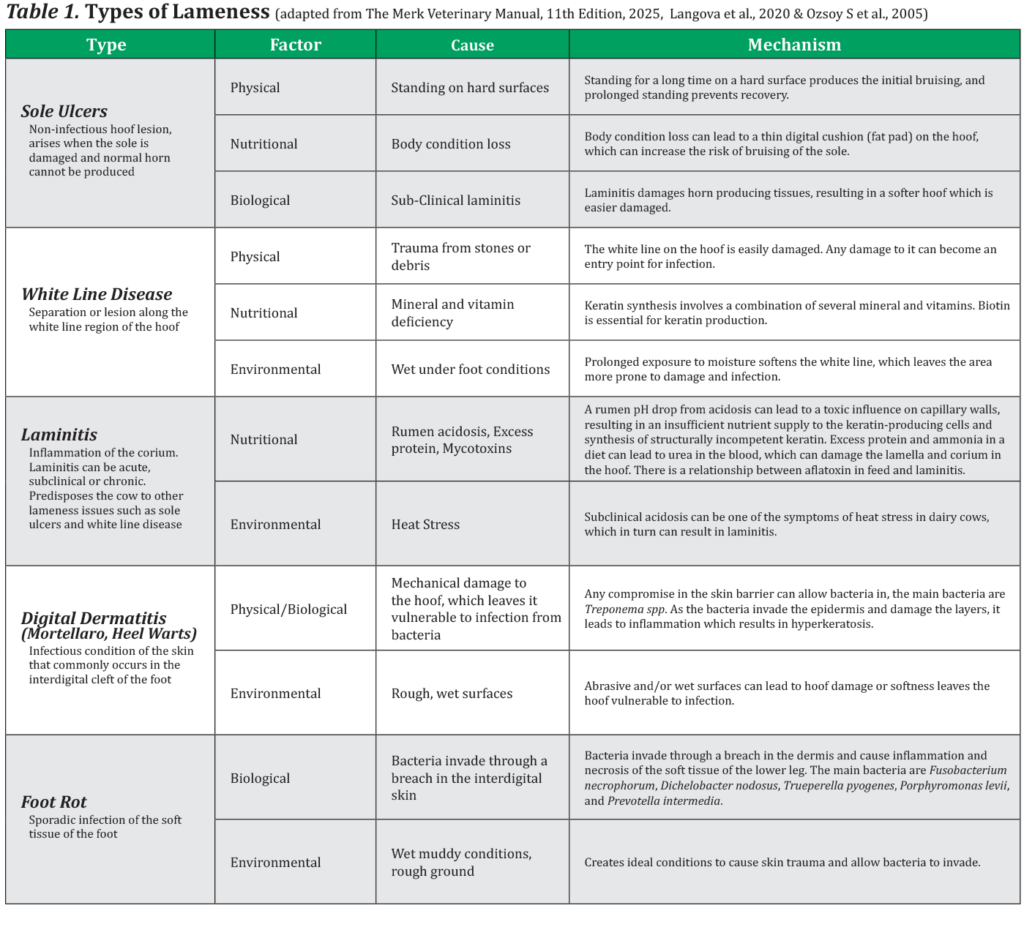
The lameness in a cow can begin with one factor and lead to another. For example, cows standing in wet pens and/or bedding can cause the hoof to become compromised and can lead to foot rot. For this reason, farms that have a high number of cows exhibiting lameness due to environmental issues should assess and address the factors on their farm that contribute to these issues. Ensuring that walking and standing surfaces are non-slip, free of sharp debris, and clear of standing water/muck, plus avoiding overcrowding and providing regular foot baths and enough comfortable cubicles for every cow in the herd will go a long way towards reducing environmental causes of lameness.
A lame cow can never reach her full potential. Once a cow becomes lame, it is likely that she will become a lame cow again. If the bone on the hoof gets damaged, it is more prone to being damaged again. Using mobility scoring is a good way to help spot lame cows in a herd before they become chronically lame. Watch cows for any signs of discomfort on their feet, such as an arched back or uneven standing. Using mobility scoring to screen a herd will help lower the risk of mild cases of lameness turning into a more serious or chronic case.
Lame cows tend to have lower dry matter intakes due to the pain of walking and standing at the feed bunk. The reduced intake can lead to lower milk production. Additionally, the increased levels of the stress hormone cortisol associated with pain can negatively affect rumen function, which in turn can lead to lower milk yield.
A cow that is lame is more likely to lose body condition and have a negative energy balance compared to a non-lame cow, due to their reduced intakes. Additionally, a thin cow is more likely to become lame as the fat mobilization resulting from the body condition loss leads to a lower fat pad in the hoof, which can leave the cow more vulnerable to sole damage.
Extended periods of negative energy balance in lame cows contribute to decreased fertility. Furthermore, lameness often suppresses visible signs of oestrus, because of the physical pain of the lameness.
The additional costs and lower productivity of a lame cow often result in her early removal from the herd. The extra expenses stem not only from lower milk yield, but also from veterinary treatments, milk withdrawal, and the need for replacement animals due to culling and decreased fertility, which reduces calf numbers.
Agri-King’s vitamin and trace minerals supply the essential nutrients to support strong, healthy hooves to help tackle everyday challenges faced by the cow. Hoof King® promotes the growth of healthy hooves in cattle and provides additional supplementation for cows showing signs of lameness or hoof problems. As the hoof grows slowly, correcting lameness takes time. The hoof that is at the white line today will take 5-6 months to reach the ground, so any effect on growth at this stage, be it positive or negative, will take time to influence the lameness of the cow.
Agri-King’s Dairy Synergy Program delivers balanced rations to producers. A balanced ration reduces the risk of acidosis-related laminitis caused by excessive carbohydrates or protein. Maintaining cows at optimal body condition scores through proper nutrition helps minimize body fat mobilization, which can compromise hoof health. Additionally, the prefresh cow program ensures a smooth transition to the lactation ration to help reduce the negative energy balance associated with transitioning.
Speak to your local Agri-King representative today to find out how they can help tackle lameness on your farm.
Sources available upon request