
By Dr. James C. Coomer, Ph.D., P.A.S.
The advancement in genetic ability of the Holstein dairy cow to produce milk and milk components have been on the rise over the last decade or so. In 1993, Dr. Mike Hutjens from the University of Illinois gave a presentation at the annual American Dairy Science Association (ADSA) meeting discussing feeding the 30,000-lb herd and it was considered futuristic. It was also normal for milk fat to be good at 3.7% and milk protein at 3.0%. About 20 years later, Dr. Hutjens gave a new version of his presentation titled “Feeding the 40,000-lb Herd.” Again, it was considered futuristic.
In 2019, a Wisconsin cow named Selz-Pralle Aftershock 3918 set a new world record for single lactation production for a Holstein cow by producing 78,170 lb of milk with 4.0% millk fat and 3.1% milk protein. With the increased adoption of genomic testing, milk production has advanced even faster. In October 2025, Dr. Mike Van Amburgh at Cornell University indicated that there are reports of first lactation Holstein cows producing milk with 6.5% milk fat and 4.0% true milk protein and combined milk fat/protein production approaching 9.0 lb. This much advancement in genetic potential has changed the way we need to look at nutrition for these dairy animals compared to a generation ago.
A couple of generations ago (30-40 years ago), we mainly balanced dairy diets based on crude protein and total digestible nutrients (TDN). Soon thereafter, the idea of net energy system was developed and Net Energy of Lactation (NEL) became the norm for balancing energy for dairy diets. At about this same time, amino acid nutrition in monogastric animal nutrition started making advancements. This generated discussions about amino acids in dairy nutrition. However, the fermentation that happens in these compartments allowed advancements in amino acid nutrition for dairy cattle to advance at a slower rate.
Over the last 20 years, there have been several ideas about how to look at amino acids in dairy nutrition from the ratio of Met:Lys (Dairy NRC 2001, 3:1 ratio), to essential amino acid supply (especially methionine and lysine) in grams per day. Both ideas proved to be difficult to supply consistent results. Part of the reason for these inconsistencies may be because amino acids are used for more than just building blocks for milk protein. They are also building blocks for enzymes and hormones that are important in milk and component production. The focus has also expanded to other amino acids, such as histidine and some of the non-essential and branch chain amino acids that may be limiting the responses.
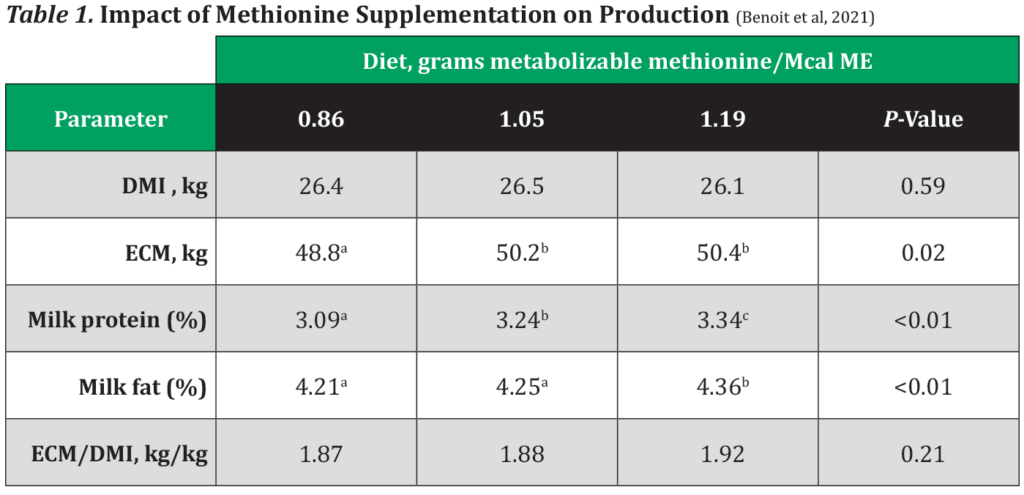
Recent research out of Cornell University (Benoit et al, 2021) looked at supplying amino acids (methionine, histidine, and lysine) in a ratio to metabolizable energy (ME) varying the amount of methionine (from low 0.86 g/Mcal ME to 1.19 g/Mcal ME) fed while keeping histidine and lysine at a consistent level (considered to be adequate, 1.19 g/Mcal ME histidine, 3.09 g/Mcal ME lysine). The diets were all similar in crude protein (15%), aNDF (32%), starch (25%), and sugar (5.75%). The results in Table 1 show that, by increasing methionine, production of milk protein increased, but production of milk fat also increased significantly. This concept may prove to be the best yet for amino acid nutrition in dairy cattle feeding.
While a lot of attention has been given to amino acid nutrition, the last 10-15 years research has proven to be informative for fatty acid content in diets and the effects on milk and milk fat production, fatty acid content of milk, and the impact on some aspects of reproduction. The feeding of higher levels of palmitic (C16:0) acid has proven to increase milk fat content in some dietary situations. Research from Dr. Adam Lock’s team at Michigan State University has shown that the ratio of palmitic acid to oleic acid in the diet in early lactation compared to mid- or late-lactation has been shown to affect milk production.
Sugar and soluble fiber also appear to be important in milk fat production, as the fermentation of these carbohydrates produces more butyric acid. Butyric acid is an important building block for milk fat synthesis in the mammary gland. Thus, the supplementation of sugars (using molasses, whey, or candy meal) in the diets becomes more important than previously thought as we try to optimize diets to fit the genetic potential of the modern Holstein cow to produce higher component milk.
At Agri-King, we are continually striving to incorporate the latest research knowledge into our nutrition programs to help our clients get the most out of their modern cows.