
By Dr. Adrian Baker, Ph.D.
As harvest approaches, the question of how much earlage or high-moisture corn needs to be harvested is being asked. Unfortunately, plans never seem to come together and inventories can be short of what is needed for the feeding period. That can lead to another question no producer wants to ask: What are we going to feed when we run out? One option is purchasing dry corn and feeding rolled corn after ensiled feeds run out. However, diet changes late in the feeding period generally never end well. Is there a second option that producers can utilize?
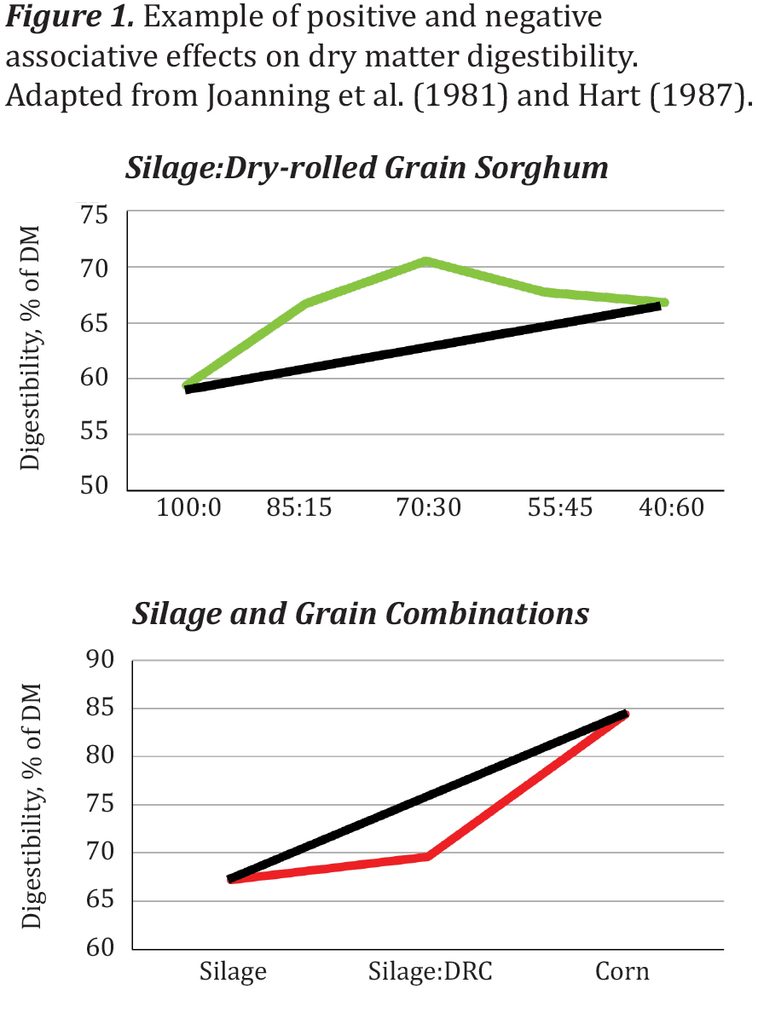
An associative effect is the impact one feed has on the digestion of another feed and has been observed in several experiments. Joanning et al. (1981) reported a negative associative effect for dry matter (DM) digestibility when combining silage and cracked corn. The study was conducted using 100 percent silage and cracked corn as the two controls. A negative associative effect is defined as a significant deviation from a linear response and, when combining 2:1 cracked corn to silage, a lower-than-expected DM digestibility was observed (Figure 1). A positive associative effect was demonstrated by combining smaller proportions of ground sorghum with silage to increase DM digestibility (Figure 1; Hart, 1987). Positive associative effects can also occur with combinations of different grains or grains processed by different methods. This is the second option that is available for producers when inventory is an issue, but is it worth handling two concentrate sources or is it easier to deal with the transition when the ensiled source runs out?
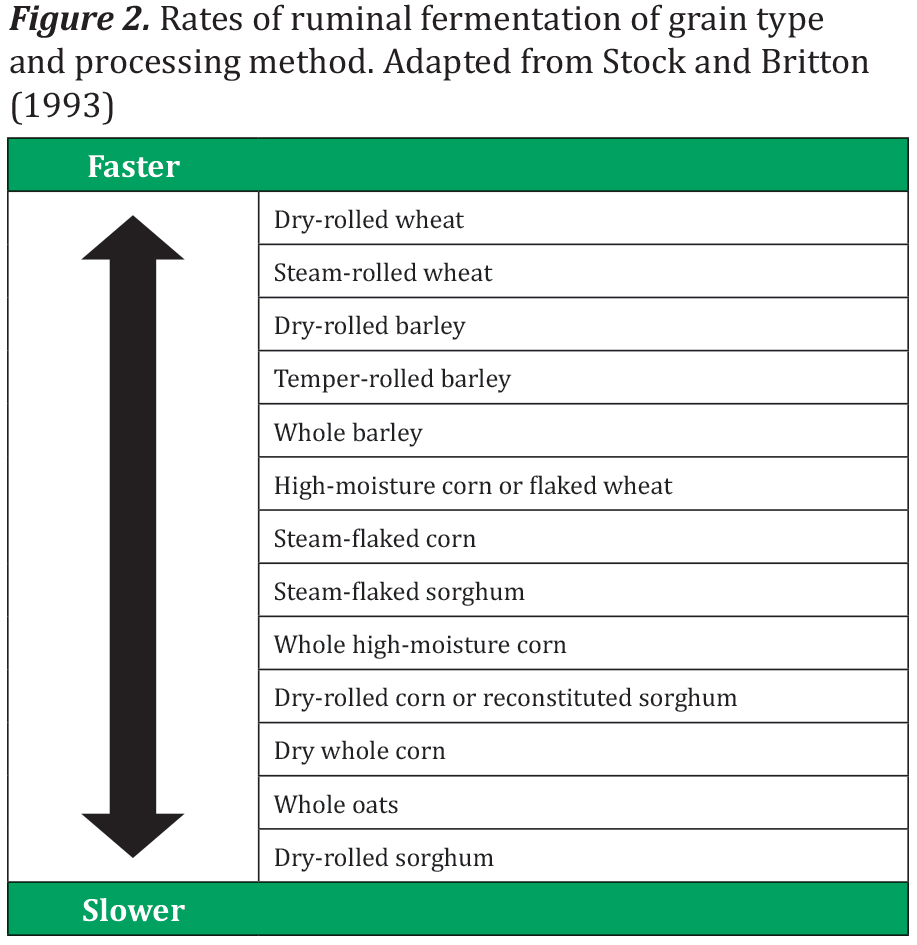
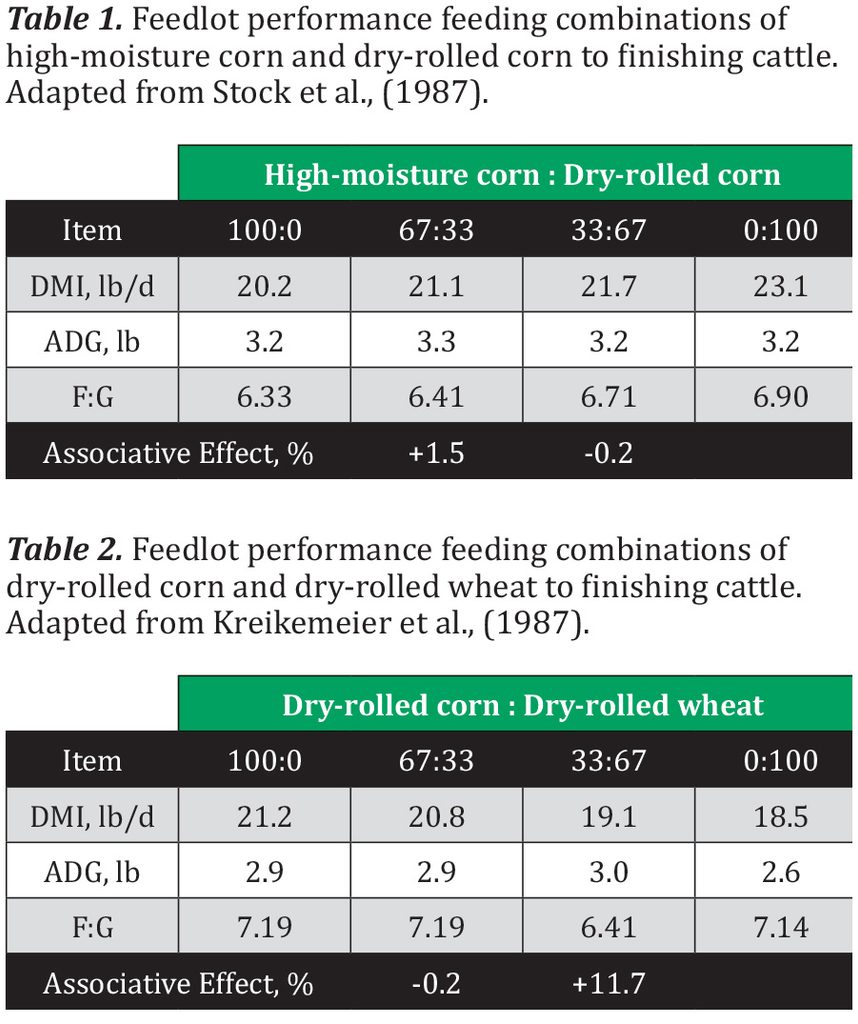
Grains have different rates of digestion depending on grain species and/or processing as shown in Figure 2. In experiments combining high-moisture corn (HMC) and dry-rolled corn (DRC), researchers observed a positive associative effect feeding 67% HMC and 33% DRC (Table 1), which resulted in a 1.5% improvement in feed:gain (F:G) compared to the predicted feed efficiency (Stock et al, 1987a). Researchers also evaluated combinations of HMC and dry-rolled grain sorghum (DRGS). This study compared a rapidly-fermenting grain source with a relatively slow-fermenting source and observed a large positive associative effect for F:G at 75% HMC and 25% DRGS (Stock et al, 1987b). Similarly, Kreikemeier et al. (1987) observed a positive associative effect when dry-rolled wheat was combined with DRC and reported an improvement in F:G for the grain combinations compared to individual grain sources (Table 2). However, when two rapidly fermenting grain sources are fed in combination, such as HMC and steam-rolled barley (SRB), F:G decreased linearly in response to increasing proportions of SRB (Duncan et al., 1991).
Positive associative effects can occur when grain combinations are fed, especially when feeding a rapidly-fermenting and slow-fermenting grain source in combination. This feeding strategy can be utilized to extend the inventory of ensiled grains, which will avoid a large diet change midway through the feeding period, while improving feed efficiency beyond what would be expected. Agri-King’s nutrition consultants can offer diet solutions to accommodate challenges with ingredient inventory without compromising feedlot performance. Additionally, by utilizing Agri-King’s Analab to determine ingredient DM and nutrient profile, Agri-King’s nutrition consultants can assist in more accurately estimating inventory and offer a forage treatment proven to reduce DM loss during ensiling.
Sources available upon request