
By Dr. Dan Schauff, Ph.D., P.A.S.
In the March 2026 edition of the Agri-King Advantage, Dr. James Coomer discussed how the genetic potential of dairy cows to produce milk and milk components has greatly increased in the past couple of decades. Many ingredients are being used in dairy rations, such as direct-fed microbial/enzymes, rumen-protected amino acids, methionine analogs, rumen-protected fatty acids, full-fat oilseeds, and sugar-containing ingredients to support higher milk fat and protein production.
Conventional whole roasted soybeans have also been used as an ingredient to supply added fat and rumen bypass protein to dairy cows. However, depending on how many roasted beans are fed, how they are processed, and what is fed with them, they can be a risk factor to depress milk fat. In fact, most fat/oil in dairy cattle diets are in the form of unsaturated fatty acids (Table 1).
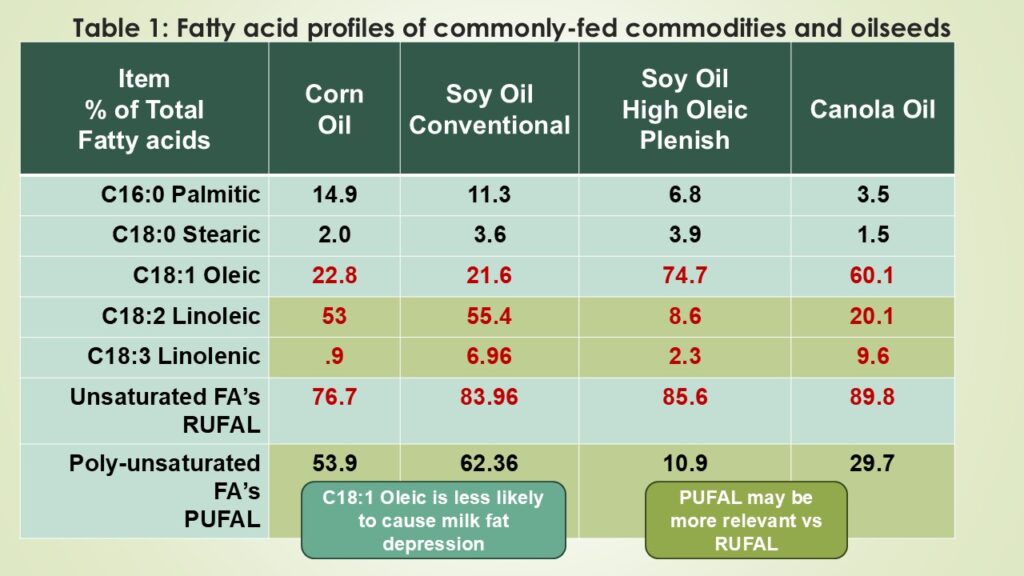
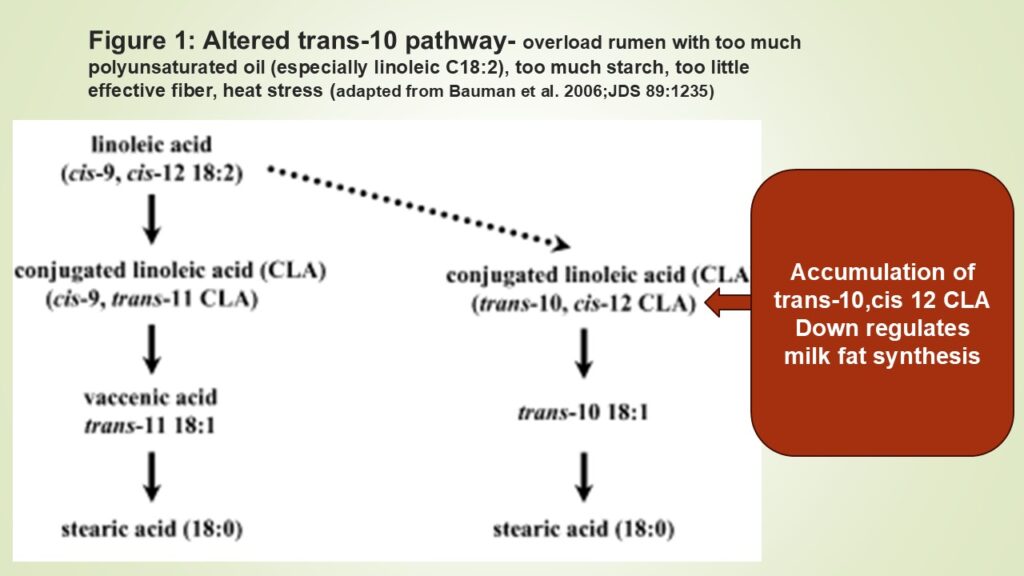
The three most common unsaturated fatty acids are Oleic C18:1, Linoleic C18:2, and Linolenic C18:3. Rumen unsaturated fatty acids are toxic to most rumen microbes because they can make the cell membranes of bacteria, protozoa, and fungi more fluid, leakier, and less stable. As a result, rumen microbes have metabolic pathways to biohydrogenate the unsaturated fatty acids to saturated stearic acid (Figure 1, left side).
When the ration contains too much rumen-degraded starch, too little effective fiber, and/or too much rumen-available unsaturated fatty acids, this can overwhelm the biohydrogenation metabolic pathways in the rumen. When this happens, an alternative pathway produces a conjugated linoleic acid isomer (CLA) called trans-10, cis-12 CLA (Figure 1, right side). This isomer is a potent inhibitor of milk fat synthesis in the mammary gland, resulting in milk fat depression. Isomers of Oleic C18:1 are much less potent inhibitors of milk fat synthesis than CLA isomers of C18:2 linoleic acid.
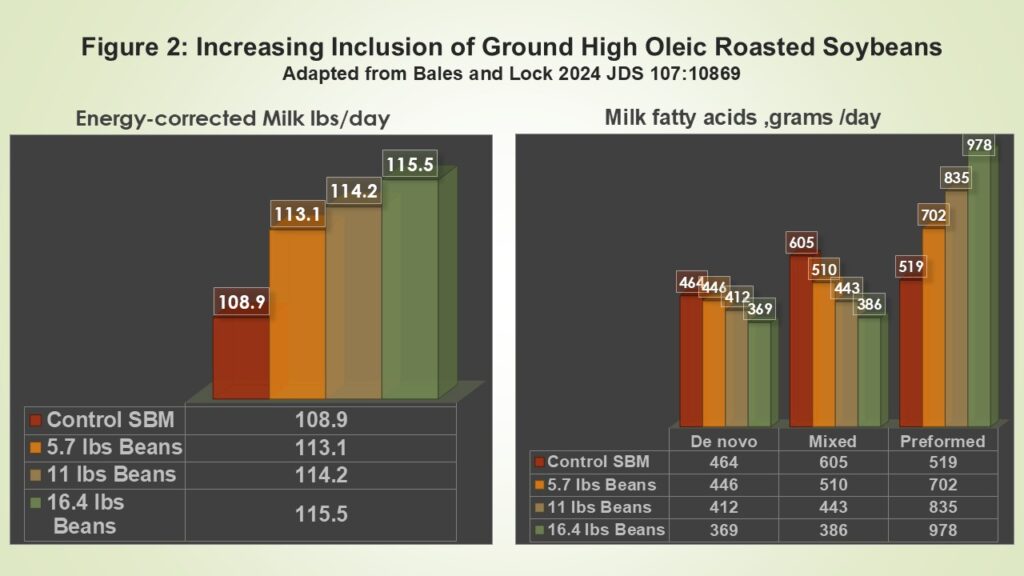
Oil seed sources that contain higher oleic acid and lower linoleic acid, like canola and high oleic soybeans, are less likely to overload the rumen biohydrogenation pathways. Several studies have observed increases in fluid milk and milk fat production, resulting in improved energy-corrected milk (ECM) production (Figure 2). ECM was linearly and quadratically increased with increased pounds of ground high oleic roasted soybeans fed. However, the largest increase was observed at the 5.7 lb feed rate. The increase in milk fatty acids mainly came from preformed fatty acids, presumably coming from fat/oil in the diet. De novo and mixed milk fatty acids were decreased, especially at the higher levels of high oleic roasted beans feeding rate (Figure 2).
The bottom line is high oleic roasted soybeans are an excellent ingredient option to help dairy producers better realize the genetic potential to produce milk components in their herd. In addition, if a dairy producer can grow their own high oleic beans, this could be an opportunity to reduce purchased feed costs.
Q: How should the soybeans be processed?
A: It is generally recommended to crack beans into quarter- to eighth-size pieces. Grinding finer may further improve digestibility, but there could be flowability problems grinding much finer than 700 to 800 microns. More research is needed on this. To avoid potential rancidity issues, roasted soybeans probably should not be processed more than a month before feeding.
Q: Can raw high oleic beans be fed?
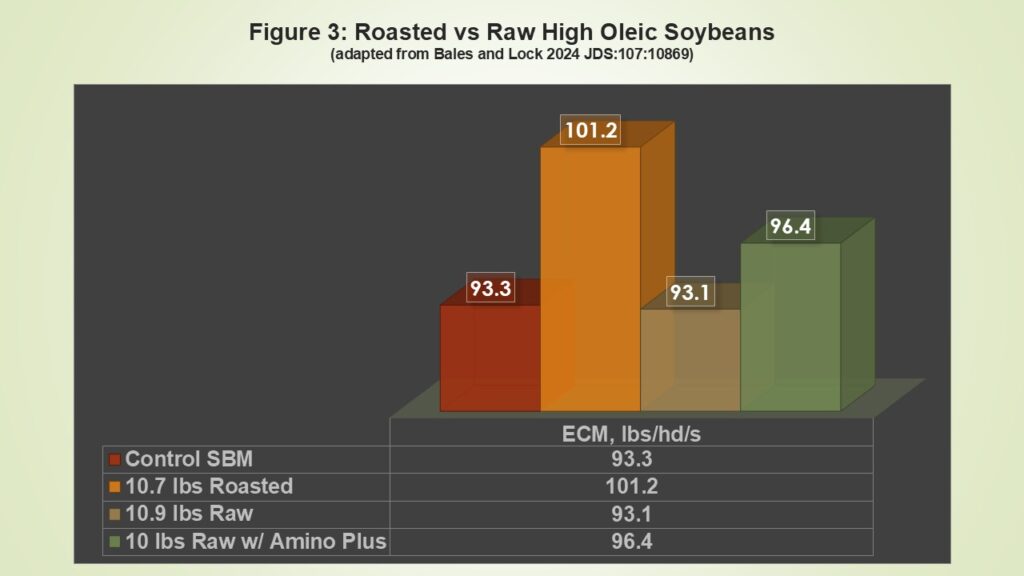
A: High oleic raw beans can be fed, but the presence of urease enzyme and trypsin inhibitor (trypsin is an important protein-digesting enzyme in mammals) in raw beans limits how much can be fed (up to 5 lb). In addition, urea should not be fed with raw beans as there is a risk for ammonia toxicity (due to the urease enzyme). Optimal roasting will inactivate the urease enzyme, trypsin inhibitor, and improve rumen bypass protein and overall feeding value. Michigan State University research reported better energy-corrected milk response to roasted high oleic soybeans vs raw high oleic soybeans (Figure 3). Raw soybeans should not be processed much more than one week before feeding, as they are more prone to going rancid than roasted soybeans.
Q: What are the upper feeding limits for high oleic soybeans?
A: Results from the Michigan State titration study (Figure 2) indicate that up to 16 lb of roasted high oleic soybeans can be fed. However, they also reported that de novo and mixed fatty acid production decreased significantly at the higher levels of high oleic soybean feeding. This may point to a decrease in fiber digestion due to a possible limitation in rumen-degradable protein and a negative effect of high oleic soy oil on the rumen microbes. More research is needed to learn how best to balance rumen-degradable protein and other rumen-protected fat sources around high oleic roasted beans to better optimize milk fat production. Feeding rates of 3-9 lb is a good starting point.
Q: Can rumen-protected fat sources be reduced or removed from the ration to save on purchased feed costs?
A: It should be possible to reduce the use of rumen-protected fat sources. However, they still can have an important role in rations to complement high oleic roasted soybeans by supporting an even better energy-corrected milk production together. We have more to learn about this.
Q: How can I verify that the soybeans have been optimally roasted?
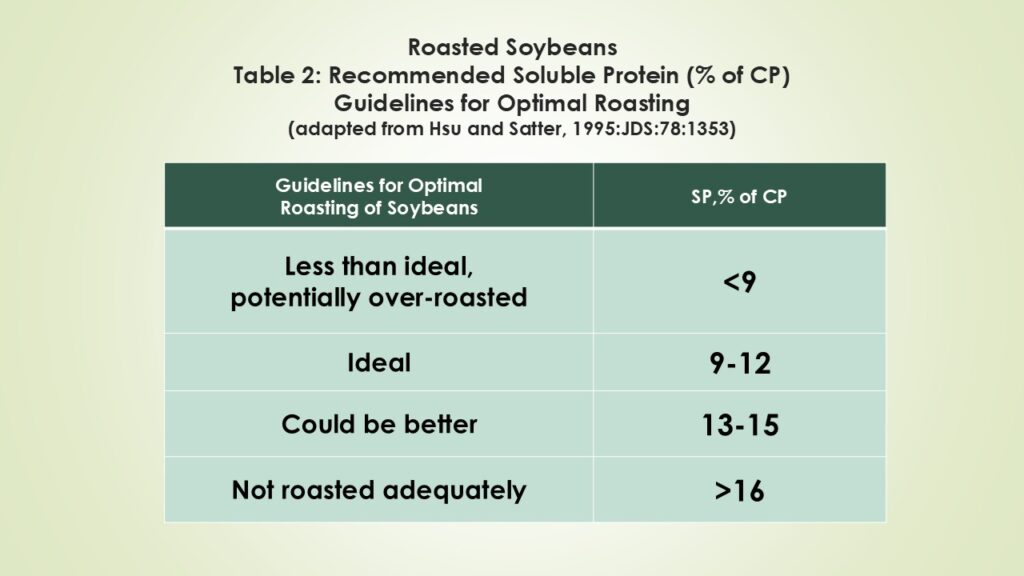
A: Water-soluble protein assays like protein dispersibility index (PDI) can be used to verify optimal roasting. There are labs that can perform PDI assays in roasted soybeans. Agri-King’s Analab has developed a soluble protein assay that closely matches PDI values. The optimal soluble protein or PDI range is 9-12 (% of the CP) (Table 2).
Although there is more to learn, high oleic soybeans can be an excellent addition to dairy rations to potentially decrease purchased feed costs (if homegrown) and improve milk and milk component production. Agri-King’s Analab can test your roasted beans to confirm if they were optimally roasted by our soluble protein assay. Contact your local Agri-King nutrition consultant on how high oleic soybeans may fit in your ration.