
By Dr. Adrian Baker, Ph.D.
Newly-received calves can be challenging and every producer it seems has a story of a group of calves that will never be forgotten for all the wrong reasons. Commonly, those calves have been recently weaned and exposed to additional stressors, such as commingling at auctions, feed or water restriction, and transportation, which can put them into a negative energy balance and may make them more susceptible to illness.
Chromium supplementation has been researched across all species of domestic livestock and has been shown to improve insulin sensitivity and subsequent glucose uptake (Spears, 2024). Chromium feed additives were not approved in the U.S. for use in cattle diets until 2009, but researchers have investigated the effect of its various sources on immune responses for years. A detailed explanation of its mode of action can be found in the November 2014 Agri-King Advantage article (Jones, 2014).
Chang and Mowat (1992) initially evaluated the effects of supplemental chromium yeast with or without long-acting oxytetracycline on the performance and morbidity of receiving and growing calves. Results from these studies showed improvements in average daily gain (ADG) in receiving calves and increased total immunoglobulins in growing calves when fed chromium yeast. A follow-up study conducted by Moonsie-Shageer and Mowat (1993) evaluated supplemental chromium yeast at 0, 0.09, 0.22, and 0.45 mg/lb of dry matter (DM) to stressed calves challenged with human red blood cells. Supplementation increased serum antibody titers and tended to increase IgG following the challenge.
Currently, only chromium propionate is approved for use in cattle diets. Bernhard et al. (2012) investigated the effects of chromium propionate at 0, 0.04, 0.09, and 0.14 mg/lb of DM during the receiving period and following a lipopolysaccharide (LPS) challenge. Average daily gain increased linearly as supplementation increased in the diet and tended to decrease the number of animals requiring therapeutic treatment with antibiotics.
Steers not supplemented with chromium lost more body weight following the LPS challenge than supplemented steers. Like the previous study, a more recent experiment supplementing 0.2 mg/lb of DM of chromium propionate decreased percentage of cattle receiving at least one treatment for bovine respiratory disease by approximately 19% (Smock et al., 2020).
Chang and Mowat (1992) hypothesized that effects of chromium supplementation were due to decreased stress hormone (cortisol) concentrations. Arthington et al. (1997) evaluated effects of chromium on cortisol and adrenocorticotropic hormone (a hormone that stimulates the pituitary gland to release cortisol) in calves challenged with bovine herpes virus. Chromium supplementation did not affect cortisol concentrations and only tended to increase neutrophil concentrations post-challenge. In the prior study, calves were supplemented for 53 days before the LPS challenge and the initial studies discussed in this article used newly-received calves with unknown chromium status.
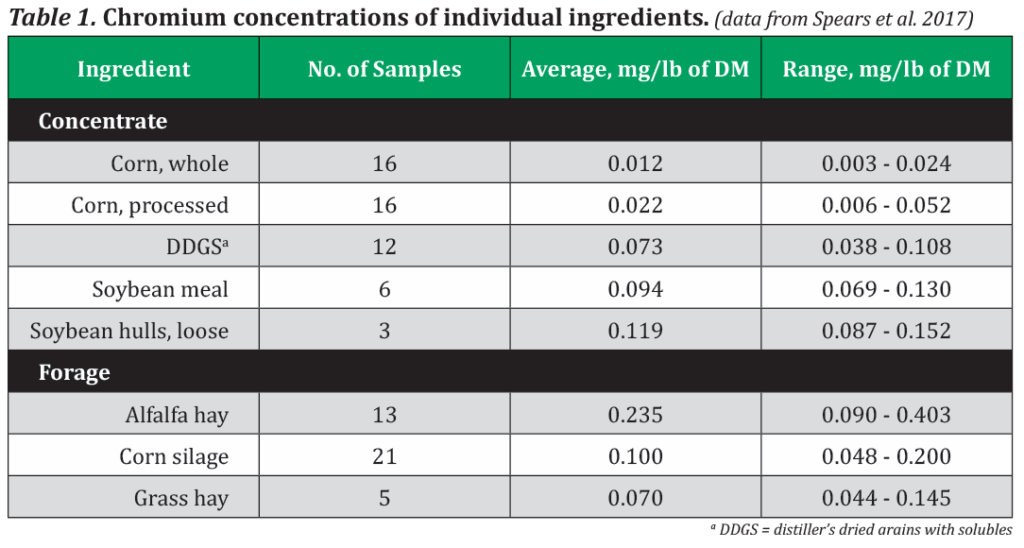
A requirement for chromium in beef cattle has not been established, likely due to the variability of responses in published studies. Feedstuffs commonly fed to cattle have shown chromium concentrations up to 0.23 mg/lb of DM; however, it is believed chromium has low bioavailability (Table 1; Spears et al, 2017). This may explain the reduced responses to supplementation in studies that utilized cattle placed on feed for extended periods before a health challenge. Once cattle intakes are sufficient, their basal diet may naturally provide adequate chromium concentrations to meet their requirements. Additionally, stressors have shown in other species to increase urinary excretion of chromium (Borel et al., 1984; Anderson et al., 1988), which may lead to a temporary deficiency in high-risk calves upon arrival until feed intake reaches adequate levels.
Chromium supplementation appears to have an impact on the immune response of newly received calves. The level of responses seems to vary, which is likely due to differences in stressors, and chromium status upon arrival to the feedlot. However, chromium status upon arrival is rarely known and supplementation during the initial receiving period has been shown to have positive results. Agri-King’s beef nutrition program and nutrition consultants can help by providing nutritional supplementation, such as Beef Jump Start, that is designed to prepare newly-received calves for challenges they will encounter during the initial transition period at the feedyard.